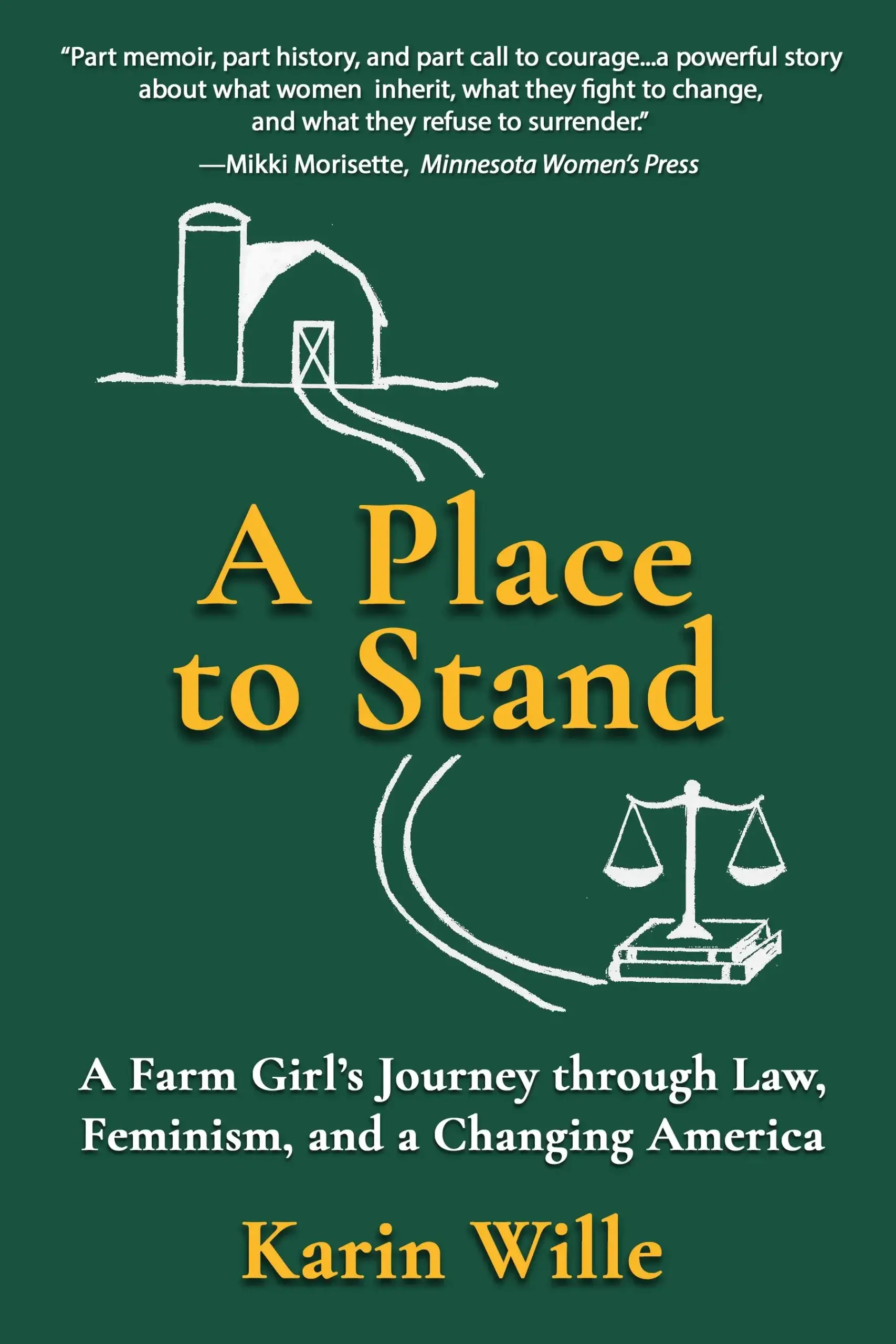
This book is a treasure, with insights for all. Karin Wille has captured a lifetime of lessons and emotions and brought them to you and me in a beautifully written and powerfully presented memoir. In my family, my grandma was the North Star—and I share this with Karin. She opens with an homage to Grandma and then takes us by the hand and walks us through high and low points, triumphs and disappointments. I reread the ‘Flying High’ and ‘Falling Hard’ chapters to remind myself one more time that this is how life is for everyone—always. Farm roots run deep; this comes to the surface over and over in this marvelous storyteller’s gift to us all.
—Mark Ritchie, former Minnesota secretary of state and former president, Institute for Agriculture and Trade Policy
The Rev. John Cummins, Minister Emeritus of First Universalist Church, wrote: ‘Each of us in our lifetime climbs the mountain of human experience… and when we reach the heights and see what is to be seen therefrom, we lie down on that mountain of human experience and the small measure of our dust adds to its height—whereby our peers and companions and those who come after us may see a small way further than we. And that is our immortality!’ In this brilliantly interwoven book of family, state, and country history, Karin adds no small measure of dust to the mountain of human experience. Her stories continuously complexify and add to our individual and collective stories, raising the height from which we can view the past, present, and future. The value of interdependence, the strength of the human spirit, and the practices of compassion and care come through across the generations. The once celebrated—but ultimately false—practices of ‘pulling ourselves up by our own bootstraps’ or ‘hard work, luck and timing are all you need to succeed’—are held with unflinching honesty as they dissolve in conversation with the realities of structural inequality and hidden histories. If you want a book that brings equal measures of respect, curiosity, and challenge to the past, while demonstrating how to live a life of purpose and meaning while expanding the boundaries of what is possible for self and others, this book is a must-read. Inspiring, illuminating, and challenging, Karin’s stories helped me to see myself again as part of a larger whole, with power and pressures that are better shared.
—Rev. Jennifer Crow, Senior Minister, First Universalist Church of Minneapolis and author of Take What You Need: Life Lessons After Losing Everything
Karin Wille’s personal story of growing up in rural Minnesota and facing the opportunities and challenges to find her place in the world is uniquely enriched by her meticulous documentation of the legal and cultural changes for women and institutions during those years. This memoir is an important contribution to women’s history through the lived experience of a young farm girl who found her way to law school and advocacy for women’s rights.
—Marlene Johnson, former Minnesota lieutenant governor and author of Rise to the Challenge: A Memoir of Politics, Leadership and Love
Reading A Place to Stand was like reading some of my own family’s history. I grew up on a farm just up the road from the Wille farm. My 4-H involvement led me to a wonderful thirty-five-year career as a University of Minnesota 4-H Extension Educator. What drew me to that career were the opportunities 4-Hers had to develop leadership, public speaking and life skills; I wanted to teach those skills. It’s good to see how 4-H experiences can lead women to many opportunities for getting involved in making life better for everyone. Learning to use your voice for the common good is a valuable skill, especially in these challenging times. Reading Karin’s story can be a powerful motivator!
—Valerie Prax, retired University of Minnesota 4-H Extension Youth Development Educator
A Place to Stand is a fascinating memoir of a woman from farm girl to successful lawyer, along with being a wife, mother, and community activist. Woven into this story is an insightful history of the evolution of women’s rights. A wonderful read for women and men of all ages to understand the strides women have made, and what we must be careful not to lose.
—Karen Evans, retired attorney and former board chair of The Advocates for Human Rights
This book is important for people like me, a member of Karin’s generation, to read to remind us how far we’ve come. But it may be more important for generations after ours to recognize that just as quickly, those gains can be lost. Although technically a memoir, it is unlike other memoirs I’ve read: written with a gentle but firm hand, describing a critical period in the history of women’s rights. It’s a fabulous story about a young professional woman at the beginning of the second wave of the feminist movement, about earlier generations of women supporting this new feminism, and, most importantly, maintaining optimism and hope through personal sorrow and great loss.
—Senior Judge Elizabeth V. Cutter, Minnesota District Court
At its core, storytelling—especially through first-person narratives—has the power to shape society’s understanding of truth, injustice, and what is essential for building healthier communities. As a women’s rights attorney during the early years of second-wave feminism, Karin witnessed—and helped shape—a generation’s fight for equality. Her perspective reaches back to her grandmother Pearl, a farm woman who was thirty before she could vote, and forward to her daughter’s response to federal immigration actions and her granddaughter’s loss of reproductive rights. Part memoir, part history, and part call to courage, this is a powerful story about what women inherit, what they fight to change, and what they refuse to surrender. As she writes: “Your choices will be constrained by forces you did not create, but constraint is not the same as surrender.
—Mikki Morisette, publisher and editor, Minnesota Women’s Press and author of Choosing Single Motherhood: The Thinking Women’s Guide
This is a timely memoir that describes a life from early days of herding cows to practicing law at major law firms. It includes thoughtful discussions of three waves of feminism and the building and tearing down of societal fences during a tumultuous time in America. The importance of faith and friendship while navigating major life changes, including the death of loved ones, makes this a book that should be read and discussed.
—Tom Berg, former member, Minnesota House of Representatives, former United States Attorney for Minnesota, and author of Minnesota’s Miracle: Learning from the Government that Worked
Karin Wille’s memoir is both moving and delightful. Born several years after World War II into a southern Minnesota farmhouse that has electricity, but not yet running water, Karin’s childhood is filled with warmth, love, hard work, and intelligent women. The Minnesota State Fair and 4-H bookmark her coming of age. Karin’s college years and law school training were during the heart of the second wave of feminism. Her determination as a lawyer, parent, and community member are anchored in her belief that women can do anything. And truly she does.
—Maureen Millea Smith, retired librarian and Minnesota Book Award-winning novelist of When Charlotte Comes Home
A poignant and enjoyable memoir of a farm girl navigating family, feminism, the law, and life, a life well lived.
—Stephen Befort, professor emeritus, University of Minnesota Law School
I really enjoyed this book, from Karin’s childhood on a Minnesota farm to law school and a very successful career as a lawyer and advocate. I began practicing law in the late 1990s, a time when women were well established in the profession, but when being a woman lawyer could still mean navigating expectations and obstacles our male colleagues rarely had to consider. Reading this book reminded me how much the opportunities available to my generation were built by women like Karin, who entered the profession when there were far fewer women in law schools, courtrooms, law firms, and corporate legal departments, and who pushed against barriers that once seemed firmly fixed in place. A Place to Stand also made me think about how much women of my generation owe to the women who came before us. They were willing to be among the first, to challenge the way things had always been done, and to make room for the women who followed. I’m grateful to Karin and others like her for doing that. My generation of women lawyers had opportunities they did not, in no small part because of the paths they helped create.
—Cheryl Dalby, Minnesota attorney